|
The peninsula called Wing's
Neck extends from Pocasset on Cape Cod out into Buzzards Bay,
a busy thoroughfare in the nineteenth century. The land where
the lighthouse is located was once swampy and mosquito-infested.
Congress first appropriated $5,000 for a lighthouse at the tip
of Wing's Neck in 1837, but the project was delayed after some
debate about whether the light was really needed.
There was plentiful iron ore in the area's swampy terrain,
and several foundries -- including the Pocasset Iron Company
-- were established by the mid-1800s. These businesses added
volume to the local shipping traffic, with many vessels traveling
to and from Sandwich and Wareham, to the northwest. As maritime
traffic in the vicinity increased, Congress appropriated $3,500
for a lighthouse in August 1848.
The first lighthouse, built in 1849 for $3,251, was a so-called
Cape Cod-style structure, with a white, wooden hexagonal tower
and lantern room on top of a stone keeper's house. The light
was 38 feet above the ground and 50 feet above the water. In
the 1870s, it was reported that the weight of the lantern was
crushing the roof of the dwelling.
The
first keeper, Edward Doty Lawrence, was removed in 1854 for belonging
to the wrong political party. Lawrence returned as keeper in 1865 and
remained until 1887, serving a total of 28 years at Wing's Neck.
Lawrence's daughter, Caroline, was later married to Keeper Albert
Gifford. (Thanks to Fleming Wright for this information.)
John Maxim, who was keeper in the 1850s,
was killed at the Battle of Gettysburg.
The Lighthouse Board reported in 1857 that a fourth-order
Fresnel lens had replaced the earlier system of multiple lamps
and reflectors. In 1928, the lens was replaced and the light
was changed from fixed to flashing. The light was converted to
electricity in 1934.
The building was in poor condition by 1878, as is reflected
in the annual report that year:
The roof of the dwelling was repaired temporarily, and
new gutters supplied. There is no tower at this station. The
lantern is on top of the dwelling, the roof has been crushed,
and a great part of the interior of the house is occupied by
the stairway. A tower is required, and the dwelling should be
extensively repaired
A fire did further damage to the building later that year,
but repairs sufficed until 1888, when funds were finally appropriated
to rebuild the station.
The new dwelling, completed in 1890 on
the original foundation, was a wood-frame structure, 28 by 31
feet.
A hexagonal wooden lighthouse tower was erected next to
the dwelling, with the light 44 feet above the water; the two
structures were connected by an enclosed walkway in 1899.
A pyramidal
wooden bell tower and a 1,000-pound fog bell were added to the
station in 1902. |
- Plans for Wing's Neck Lighthouse (1890)
- U.S. Coast Guard
|
- From A Trip to Cape Cod, 1898
| Albert Gifford served as keeper at Wing's Neck for 21 years,
beginning in 1887. His wife, Caroline (Carry) H. Gifford, served as his
assistant. Edward D. Nickerson, the local undertaker, described
what happened the night Albert Gifford died at the lighthouse
in October 1908:
One mean and foggy night he died in his house. I hitched
up my old nag and drove down there. Mrs. Gifford was alone [and]
as I worked on his body, she carried on through that beastly,
cold, foggy, night, tending the light and clocking the fog bell.
After finishing my work I stayed the night there. I could not
leave her way out there alone with her husband lying dead in
the parlor. The light streaming out into the foggy night and
the weird clang-clang-clang of that great bell every 1/2-minute.
I never forgot that night or the woman all alone there sticking
to her husband's responsible job.
|
Mrs. Gifford was keeper for two weeks before being relieved
by Wallace Eldredge, son of a Nantucket whaler. Eldredge earned
five Efficiency Gold Stars for excellent service during his years
at Wing's Neck. After the opening of the Cape Cod Canal in 1914, with the
its western entrance just a few miles northeast of Wing's Neck,
the local maritime traffic greatly increased.
Personnel at the
light station had to watch for any vessel approaching the canal
from the south, and they would telephone word ahead so that a
tugboat and pilot could meet the vessel for its passage through
the canal. |
|
 | For a time, the keeper's wife, Louise Eldredge served
as the official day dispatcher for the canal. She also had the
duty of flying storm signal flags at the station as needed.
President Harding once passed near the station in the Presidential
yacht Mayflower. Because of bad weather, the yacht anchored
near Wing's Neck.
In the morning Keeper Eldredge gave the President
a "twenty-one gun salute" with the fog bell. |
George Addison Howard, formerly at several other Massachusetts
light stations, became keeper in 1921. His brother, William,
previously at Boston Light, was his assistant. The sons of the
captain of the Cross Rip Lightship in Vineyard Sound, the Howard
brothers gained widespread fame as lifesavers. In one instance,
on July 14, 1931, a small boat overturned with a man and four
young boys on board, and William Howard went out in the station's
boat and rescued all five. In 1932 alone the Howard brothers
were credited with eight lives saved. "I wish they wouldn't go off here fishing or cruising
in such small craft," said William Howard, "If it comes
up a quick blow there's sure to be trouble." By the end
of William Howard's career it was estimated that he had saved
37 people.
|
- George and William Howard
|
 | In 1923, the keeper's house at Ned's Point Light in Mattapoisett
was floated across Buzzards Bay to become an assistant keeper's
house at Wing's Neck Light Station. The house is now privately
owned.
- This house was originally built in
Mattapoisett at Ned's Point Light, but was moved to Wing's Neck
in 1923. Today it's a private home.
|
- This U.S. Coast Guard photo shows
both keeper's houses at Wing's Neck
| With
the building of Cleveland Ledge Light, Wing's Neck Light was considered
expendable. The station was discontinued in 1945 and went up for sale
in 1947. It was bought by Frank and Irene Flanagan of Boston for
$13,738.
The Flanagans were a musical family and Wing's Neck Light
became a center of musical activity in the area. Their daughter,
Beth, was a concert pianist; when she was married Beth threw
her bouquet from the top of the lighthouse tower. Barbershop
quartet concerts frequently took place on the lawn, and the von
Trapp family singers of Sound of Music fame spent some
time at the lighthouse. Irene Flanagan lived at the lighthouse
until recent years; she died in 1999 at the age of 96. |

Above, the wooden stairs inside the
tower, and right, the walkway between the house and tower.
|
 |
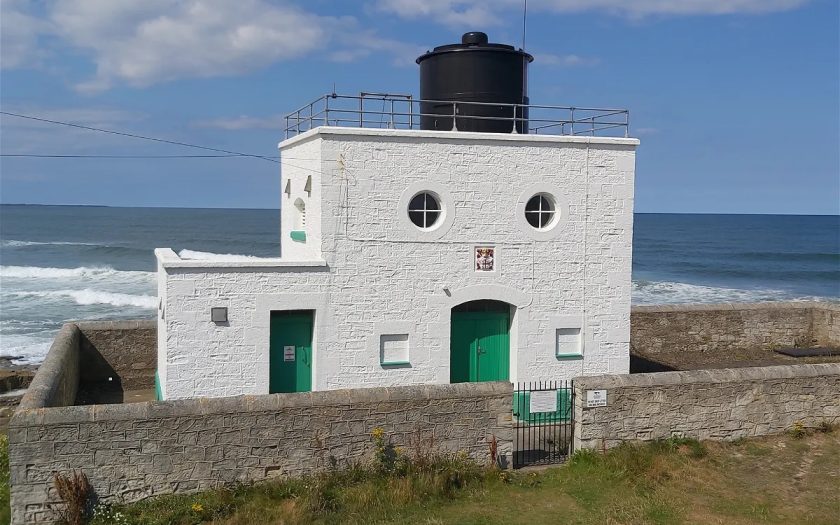
| The area around the lighthouse is a monitoring station for
the Cape Cod Canal, with radar and a closed circuit television
system. Wing's Neck Light is on private property and the grounds are
not accessible to the public. It can be viewed from a gate about
100 yards from the lighthouse. The lighthouse is available for
rent; for more information contact:
- Wing's
Neck Lighthouse Trust
- Phone: 508-460-0506
-
Email: wings_neck_lighthouse@charter.net
|
- The radar tower at Wing's Neck
|
You can read much more about this lighthouse in the book The Lighthouses
of Massachusetts by Jeremy D'Entremont.
Keepers: (This
list is a work in progress. If you have any information on the keepers
of this lighthouse, I'd love to hear from you. You can email me at nelights@gmail.com.
Anyone copying this list onto another web site does so at their own
risk, as the list is always subject to updates and corrections.) Edward Doty Lawrence (1849-1854 and 1865-1887);
Samuel Barlow (1854-?); ? Wright (?); ? King (?); John Maxim
(c 1850s); Albert Gifford (1887-1908, died in service); Caroline Gifford
(wife) (1908); Wallace Eldgredge (1908-1921); George Howard (1921-1937);
William Howard, assistant (1920s).
|