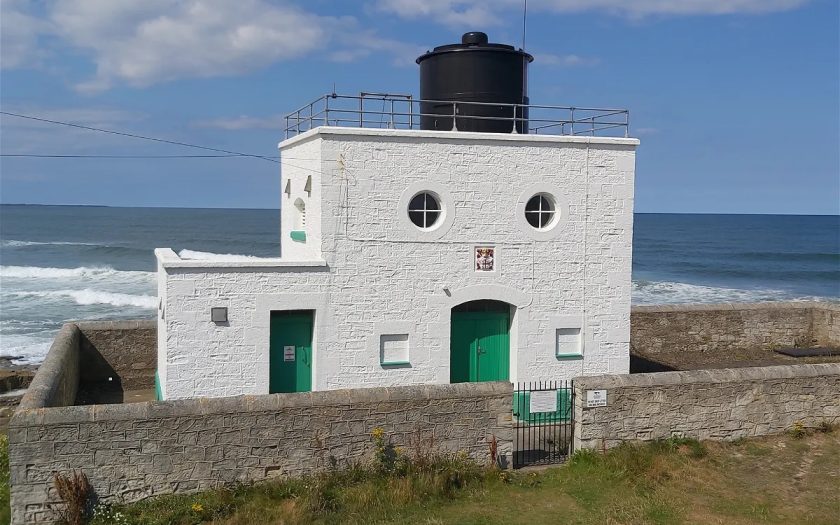
Congress appropriated $5000 for the light station on April 21, 1806. The contractors Beal and Thaxter built the first wooden lighthouse on the site, along with a small dwelling, in 1808. It was the first American lighthouse east of Penobscot Bay.
Godfrey’s job was complicated by the War of 1812, when British troops claimed control of the light station. Just a few miles away, the British occupied the town of Eastport for a lengthy portion of the war. An officer promised Godfrey that the British would pay him, but the salary was not forthcoming. The local customs inspector wrote a letter to the U.S. lighthouse authorities on Godfrey’s behalf, as he hadn’t been paid in several months and was “very poor” and had a “large family to support.”
Over the next 17 years, four different fog bells were tried at West Quoddy, but all of them were difficult to hear offshore. Even an unusual 14-foot steel bar was tried in place of a bell. The first lighthouse was so poorly constructed that it required rebuilding by 1830. Congress appropriated $8000, and the contractor Joseph Berry rebuilt the tower in 1831 for $2350. The new rubblestone lighthouse, 49 feet tall, went into service on August 1, 1831. Keeper Alfred Godfrey related some not-too-pretty details of life at West Quoddy in 1842 to I.W. P. Lewis for his important 1843 examination of the Lighthouse Establishment. Godfrey wrote:
The station was assigned an assistant keeper beginning in the 1850s. Ephraim N. Johnson, a native of the Washington County, Maine, town of Roque Bluffs, arrived as the assistant in 1900. When he advanced to principal keeper in 1905, Johnson’s pay was raised from $480 to $660 yearly. Johnson’s four children, and later his
grandchildren, helped the keeper and his wife, Ada (Miller), with the
chores at the station. Gwen Wasson, Johnson’s granddaughter, recalled
some details of life at West Quoddy for an article by Ron Pesha in Lighthouse Digest: He
felt like a very rich man. He loved it, there on the ocean, doing what
he wanted to do with his family around him. And we never lacked for
food. Grandmother kept chickens and sometimes raised pigs. Sometimes we went up the tower to assist polishing the brasswork. Grandfather said that you can’t leave any finger marks, because they collect dirt.
Ephraim Johnson was assistant 1901-05 and principal keeper 1905-31. Courtesy of the West Quoddy Head Light Keepers Association.
Johnson called the local Coast Guard station, and soon followed the assistant keeper, Eugene Larrabee, who ran down the shoreline with a supply of rope. Arriving at the scene of the disaster, Searles saw an enormous two-masted ship stuck in a crevice in the rocky cliff. Larrabee and another man were able to get a line to the ship, and the crewmen climbed one at a time onto the rocks, After the men were safely rescued, the ship slid off the rocks, and within minutes it was sunk out of sight except for the tips of its masts. Searles also recalled his grandfather telling him tales of a pirate named Gulliver, who supposedly buried treasure not far from the lighthouse. Armed with a small shovel, young Searles dug enthusiastically at a location known as Gulliver’s Hole, in a cove about a half-mile from the light station. All he found was an occasional bottle or anchor chain, but Searles never gave up his belief that pirate loot was hidden in the vicinity. Arthur Marston was an assistant keeper in the 1920s. His granddaughter, Jenine Marston Christensen, later recalled a conversation she had with Marston. While on a visit to the lighthouse, she asked him if the foghorn kept him awake. He replied, “Only when it stops!”The keepers’ children had to walk about two miles to school in Lubec. One day in the 1920s, Marston’s children found some lumber that had washed ashore. One of the boys took the lumber and built a cabin in the woods that long served as a meeting place for local children and was still standing into the 1990s. Howard “Bob” Gray was the keeper from 1934 to 1952. His father, Joseph M. Gray, had been a keeper at Mount Desert Rock Light, Bass Harbor Head Light, and other Maine stations. Bob Gray had the distinction of being the last civilian keeper and the first Coast Guard keeper at West Quoddy Head, as he joined the Coast Guard after they took over the management of the nation’s lighthouses in 1939. Gray’s image was immortalized in the September 22, 1945, cover illustration of the Saturday Evening Post; the painting by Stevan Dohanos portrayed the keeper tending the lawn near the base of the lighthouse. ![]() Howard
“Bob” Gray, seen here in the kitchen in the keeper’s house, was the
keeper at West Quoddy Head Light 1934-52. Courtesy of the West Quoddy
Head Light Keepers Association. Gray was fondly remembered in the publication 200 Years of Lubec History as a “sturdy, friendly man in shirtsleeves—even on a winter day.” It was said that Gray kept the lighthouse and fog signal building so clean you could eat off the floor, and he always had a welcoming smile for visitors. He was happy to give impromptu tours, and often invited visitors in for a cup of tea. During World War II, Gray’s daughters, Dorothy and Carolyn, and some friends found what appeared to be a bomb in the surf at a nearby beach. They put the bomb in the back seat of Carolyn’s old Chevy and drove it home, over numerous bumps and potholes, to show their father. Gray told his children not to touch the bomb or to move the car, and he immediately phoned Washington. Luckily, as Dorothy Gray Doble-Meyer explained in an article in Lighthouse Digest, it turned out the bomb wasn’t active; it was a German-made decoy. Click here to see film taken by historian Edward Rowe Snow at West Quoddy Head circa early 1950s (courtesy of Dorothy Bicknell). The keeper seen is this clip is Bob Gray, who was at West Quoddy Head 1934-1952.
The last Coast Guard keeper at West Quoddy Head before its 1988 automation was Malcolm Rouse. Asked by the Boston Globe what he thought of automation, Rouse responded:
Lubec resident Maurice Babcock,Jr., whose father was the last civilian keeper of Boston Light, said:
Malcolm Rouse's wife, Carol, added, "It's a whole way of life that is being put aside."
Keepers: Thomas Dexter (1808-1813); Peter Godfrey (1813-1839); Alfred Godfrey (1839-1842); Ebenezer Wormell (c. 1840s-50s); William Coggins (?-1856); David Joy (assistant, c. 1850s); Loring Leavitt (assistant, 1861-1867); Albert H. Godfrey (assistant, 1857-1861); William Godfrey (1856-1860); Loring A. Leavitt (assistant, 1861-1867); Richard Richardson (1860-1861); George A. Case (1861-1877); Lowell Chase (assistant, 1867-1878); Daniel Thayer (1877-1879); Joseph Huckins (assistant, 1878-1880); Henry M. Godfrey (1879-1882); Garrison Crowell (assistant, 1880-1882); William Fanning (1882-1886); Walter B. Mowry (assistant, 1882-1886); Alvin Eldrige (assistant, 1886-1887); John Connors (1886-1890); Henry M. Godfrey (assistant, 1887-1889); George W. Sabin (assistant, 1889-1890); John W. Guptill (1890-1899); Irwin Young (1890-1893); Edward L. Horn (assistant, 1893-1895); Edwin L. Eaton (assistant, 1895-1900); Fred M. Robbins (assistant, 1900-1901); Warren A. Murch (1899-1905); Herbert Robinson (assistant, 1905-1907); Eugene C. Ingalls (assistant, 1907-1912); Leo Allen (assistant, 1912-?); Ephraim N. Johnson (assistant 1901-1905, principal keeper 1905-1931); Ralph Temple Crowley (assistant? c.?1915?); Arthur Robie Marston (assistant, c. 1920s); Eugene N. Larrabee (c. 1935); Nelson Geel (?); Frank Mitchell (?); Almon Mitchell (1909-1911); Hoyt Cheney (asst., c. 1950); Howard "Bob" Gray (1934-1952); Alex Sneddon (Coast Guard, c. 1952); Don Ashby (Coast Guard, c. 1953); Robert W. Brooks (Coast Guard Fireman First Class, c. early 1950s); Pat Stevens Bradisport (Summer 1956 Officer in Charge, Coast Guard); Paul Kessler (Coast Guard EN1, 1956); Russell Reilly (Coast Guard, c. 1960-1961); Dave Hardman (Coast Guard EN2, c. 1960-1961); Howard Johnson (Coast Guard SN, 1960-1961); John W. Willmott (1959-1961, Coast Guard assistant/engineer); Stephen H. Rogers (December 1963, Coast Guard); Bruce Keene (1962-1964, Coast Guard); John Wiley Grandey II (Coast Guard, 1963-1964); Richard Copeland (1965, Coast Guard); Thomas Keene (1967, Coast Guard); Richard "Gary" Craig (Coast Guard, 1968-1969); Clifton Scofield (1974-1978, Coast Guard); Robert Marston (1975, Coast Guard); Paul Latour (Coast Guard, 1980); George Eaton (1978-1982, Coast Guard); Owen Gould (1982-1984, Coast Guard); John Richardson (1984-1988, Coast Guard); Malcolm Rouse (Coast Guard, 1988). |