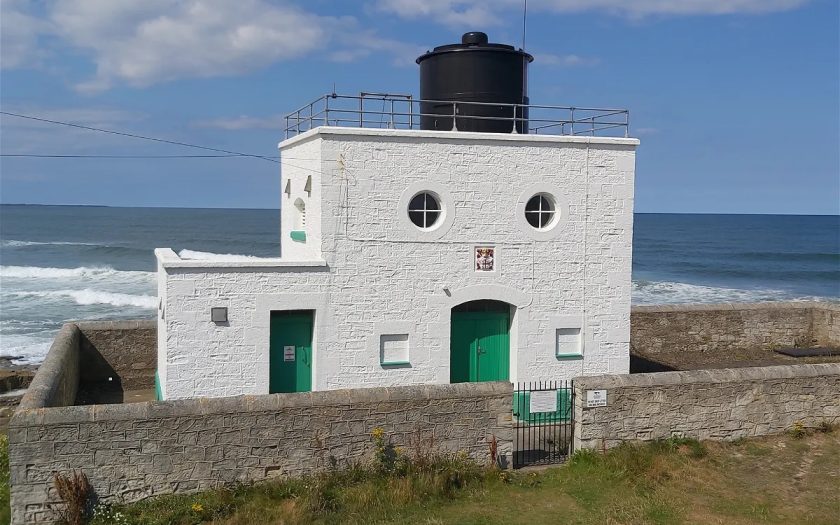
The first keeper, C. H. Salisbury, had a long 22-year stay. The Providence Journal reported in 1891 that the "lovely house" included a parlor with a piano and a hall containing a large library. A flower and vegetable garden was maintained by the Salisburys, who lived at the lighthouse with their daughter and a dog named Sailor. Salisbury remained keeper until his death in 1893, when his wife, Mary, took over for a few months.
A fog siren was installed at Pomham Rocks in 1900. One newspaper called the new signal, "The Greatest Nuisance in the State." As complaints from local residents mounted, the continuous horn was soon changed to a three-second blast at 12-second intervals. Three years later a fog bell replaced the siren. Adolph Herman Aronson was keeper for a 29-year stretch beginning in 1908. Aronson was a native of Sweden who came to America in 1890, when he was 18. He worked on vessels traveling to foreign ports until he joined the Lighthouse Service in 1899. After service on the Hog Island Shoal Lightship and the lighthouse that replaced it, he went to Pomham Rocks with his wife, Nellie (Johnson), and their three children, Marjorie, Raymond, and Elmer. According to an article in the Providence Evening Bulletin, the Aronsons brought their furniture to Pomham Rocks in small boats a little at a time. Their piano was transported on a two-masted schooner, swung between the masts. When the schooner reached the island, the crew all moved to one side, causing the vessel to tilt, and the piano was lowered gently to the rocks. A feline member of the family named Tommy 3rd landed the Aronsons in newspapers around the country. "Fish Catching Cat is Self-Supporting" read one headline. It seems Tommy the tabby would perch on the edge of the island watching for unsuspecting fish, waiting for the right moment to dive in and catch them. Sometimes only the tip of Tommy's tail could be seen above the surface as he did his work. He'd pile up the small fish under a lilac bush until satisfied he had enough for a meal. Tommy had been brought to Pomham Rocks as a kitten by the keeper's son, Raymond, who found him on the street in Riverside. His pursuit of fish had its hazards; twice Keeper Aronson had to remove fishhooks from Tommy's mouth. By the time he achieved celebrity status in the early 1930s, Tommy had lived on the island for a decade. By then, the rest of the family was spending most of the winter months ashore, often leaving the keeper and Tommy alone at the light station.
According to an article in the Providence Journal, Keeper Beebe had to observe and record the weather every four hours, day and night. He had no trouble keeping the schedule, thanks to Francine, the youngest in the family. "The baby is our alarm clock," said the keeper. "One of us is always awake." During its last years as an active aid to navigation, the lighthouse was staffed by two Coast Guard keepers, who alternated three days on the island and three days off. The last crews also had the company of two dogs, Jennifer and Pooch-Pooch, who helped keep the rats away from the small island. Pomham Rocks' original Fresnel lens was replaced by a fourth order lens in 1939. This lens was removed in 1974 and is now on display at the Custom House Maritime Museum in Newburyport, Massachusetts. The lighthouse was discontinued in 1974 and was replaced by an automatic light on a skeleton tower. When they learned it was to be decomissioned, the Rhode Island Historical Society stepped in and took temporary possession of the lighthouse. In 1980 the General Services Administration sold the property to the Mobil Oil Company, which has a large refinery and terminal near the lighthouse, for a winning bid of $40,100. Mobil stated that they wanted to "preserve the continuity of the waterfront area." Bob and Susan Charbonneau were the first caretakers. In 1976, 26-year-old Stephen Allen became the new caretaker. Allen was the brother of Susan Charbonneau, and their brother, Chris, also helped out on occasion. Stephen worked during the day at his father's boatyard and returned to the lighthouse each evening. Allen enjoyed his solitary hours on the island. "It gets me away from everything," he said, "but not too far away. . . . And it's a weird place to be in a storm." In recent years there has been no caretaker on the island. ExxonMobil has leased the historic structure at no cost to the American Lighthouse Foundation. At a meeting in early 2005 in East Providence, a new chapter of the American Lighthouse Foundation, the Friends of Pomham Rocks Lighthouse, was announced. At that meeting, Greg DeMarco, superintendent of ExxonMobil's East Providence terminal, presented $25,000 to the American Lighthouse Foundation toward the restoration of the lighthouse. The hard work of the Friends is now paying big dividends. On June 6, 2005, a group of representatives of the American Lighthouse Foundation, the Friends of Pomham Rocks Lighthouse, the Coast Guard, and Exxon-Mobil gathered on the small rocky island for a flag-raising ceremony. As part of the event, ALF and the chapter awarded a contract to Keith Lescarbeau of Abcore Restoration, who performed the miraculous restoration of Rhode Island's Plum Beach Light in 2003. A restoration of the exterior of the lighthouse was completed in early 2006, and it's hoped that the restoration of the interior will follow soon. On July 30, 2006, the navigational light was returned to the lighthouse - click here to read more about this. ![]()
Pomham Rocks Light can be easily viewed from the 14.5 mile long East Bay Bicycle Path that borders the Providence River. The path is open to walkers as well as bikers. Call (401) 253-7482 for more information on the bike path. You can read much more about this lighthouse in the book The Lighthouses of Rhode Island by Jeremy D'Entremont. Keepers: C. H. Salisbury (1871-1893); Mary Salisbury (1893); Thomas S. Fishburne (1898-1908); Adolf Herman Aronson (1908-1937), William J. Howard (1937-1951), Howard B. Beebe (c. early 1950s), Ernest Stacey (c. 1950s), Dennis Tardiff (Coast Guard Officer in Charge 1971-1974) |