|
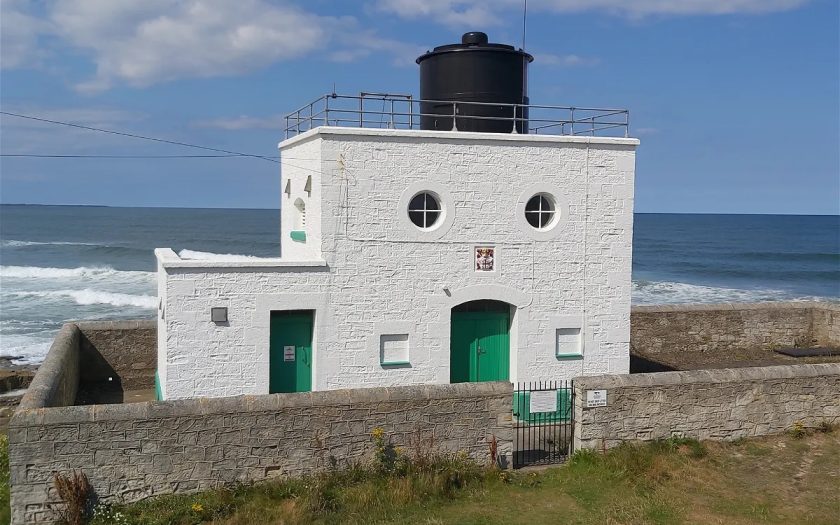
Six-acre Palmer's Island, in
the Acushnet River on the west side of the entrance to New Bedford
Harbor, has been the scene of great heroism and tragedy, and
its lighthouse was once considered one of New England's most
picturesque. For years the lighthouse and the island itself were
sad victims of neglect and vandalism, but thanks to concerned
citizens and officials of the city of New Bedford, the lighthouse
is shining once again.
The island got its name from one of the first settlers of
Dartmouth, William Palmer. Like Boston Harbor's Deer Island,
Palmer's Island was used as an internment camp for Indians during
King Philip's War in 1675-76. Most of these Indians were later
sold into slavery in the West Indies.
|
 |
New Bedford was the whaling capital of the nation in the mid-nineteenth
century. The whaling industry reached its peak in the 1850s,
when New Bedford had a fleet of 239 ships. In his 1843 survey
of the lighthouses along the coast, inspector I.W.P. Lewis pointed
out the need for a lighthouse on Palmer's Island:
This island lies directly within the entrance to New Bedford
Harbor. A single lamp beacon place upon it would add materially
to the facilities requires on entering this important harbor.
-
- Palmer Island Light with its first
"birdcage" style lantern room (U.S. Coast Guard)
-
The lighthouse on the northern point of Palmer's Island was
first lighted on August 30, 1849 by William Sherman (sometimes
spelled Shearman), the first keeper. The 24-foot tower was built
of rubblestone, with wooden windows and floors. A walkway connected
the lighthouse to the higher part of the island.
An 1850 inspection reported:
Tower of the light-house built of stone, and tight; dwelling
is of wood and somewhat leaky; lantern is a good one, and the
whole taken together is a fair piece of work... Found the apparatus
clean; but the dome of the lantern, whih was painted white, was
just as black as could be -- casued by burning Mr. Rodman's lamp
with whale oil. Swelling is too small and needs a porch.
Keeper Sherman left to become the toll collector on the Fairhaven
Bridge in 1853. Charles D. Tuell, who remained keeper until 1861,
replaced him. Joseph B. C. Tuell was born at the lighthouse to
the keeper and his wife in 1858. When Joseph Tuell died in 1935,
his ashes were spread over the island from an airplane.
- From the collection of Edward Rowe
Snow, courtesy of Dorothy Bicknell
|
Palmer's Island saw much activity during the nineteenth century.
In the 1860s, a hotel and dance hall were built on the southern
side of the island, and visitors came by steamer from New Bedford.
The hotel became a favorite stop for returning whalers, and illegal
activity grew rampant. The hotel closed around 1890 and an amusement
park was built on the island. This park failed after a few years,
and the old hotel building burned down in 1905.
George Cowie served as keeper from 1872 to 1891. He complained
that the well water was brackish and that the smoke from New
Bedford factories blew across the island, contaminating the cistern
with soot. It's unclear if anything was done to remedy the situation.
|
- The range light on the Fairhaven
Bridge
- From the collection of Edward Rowe
Snow, courtesy of Dorothy Bicknell\
|
From 1888 to 1891 a red light on the nearby Fairhaven Bridge
served as a range light with Palmer's Island Light. This arrangement
helped mariners past Butlers Flats before the lighthouse was
established there. Later for a time a light on the Wamsutta Mill
served as a range light with Palmer's Island Light.
The early 1900s saw a number of changes at Palmer's Island.
A new fog bell and striking machinery were installed in 1900
in a pyramidal wooden tower. Later, the fog bell was removed
from this tower and placed in a structure that was attached to
the lighthouse.
New stairs were also installed in the lighthouse in 1900.
The following year 75 tons of rip-rap stones were placed on the
beach to afford some protection in storms. An oil house was added
in 1905.
|
- The U.S.S. Constitution passes
Palmer's Island, August 6, 1931
- From the collection of Edward Rowe
Snow, courtesy of Dorothy Bicknell
-
|
Arthur Small, a native of Brockton, Massachusetts, came to
Palmer's Island as keeper in 1922, moving with his wife Mabel
and two sons from Boston Harbor's Narrows ("Bug") Light.
Small, one of three lighthouse keeper brothers, was a gifted
artist who often painted scenes on Palmer's Island. He had been
a seaman and lighthouse keeper since the age of 14. For 16 years
Small served on the island, operating the light and fog bell.
In 1988, a woman named Stella Hay Rex recalled attending a
sewing circle with her friend Mabel Small on September 20, 1938.
Mrs. Rex noticed that Mrs. Small was looking nervously out the
window at the ocean. She asked Mrs. Small why she looked worried,
and Mabel replied, "The sea is so rough I'm afraid Arthur
won't be able to row over to get me if I wait for my ride."
Soon Mrs. Rex drove Mrs. Small to the landing where her husband
was waiting to take her back to their lighthouse home. "See
you girls next week!" shouted Mrs. Small as they left the
dock.
|
- Arthur and Mabel Small
|
On the afternoon of the following day, September 21, 1938,
two days before Mabel Small's 48th birthday, the worst hurricane
in New England history battered the south-facing coast. During
the afternoon of the storm Arthur Small decided to light the
lighthouse. Leaving his wife in the oil house on the island's
highest ground, Small attempted to walk the 350 feet from the
house to the tower.
Part of the way to the tower, Small was struck by a large
wave that smashed him against a metal fence. As he managed to
get to his feet, he looked back and saw his wife attempting to
launch a rowboat to come to his aid. He called to her to stop,
but his voice was lost in the wind and waves. As Mabel Small
tried to launch the boat a wave destroyed the boathouse. Arthur
Small lost sight of his wife.
Somehow, injured and in shock, Arthur Small made it to the
tower. The house itself had been swept back several hundred feet
from its original site. Small lighted the Palmer's Island Lighthouse
and waited through the night, unable to leave the tower until
the storm abated. In the morning neighbors found Arthur Small
and took him to a hospital. He eventually recuperated at the
Chelsea Naval Hospital near Boston. Mabel Small had not survived.
Her body was later found and identified in Fairhaven.
-
- Arthur Small (courtesy of Jeremy
Burnham)
|
The Boston Traveler reported:
Mrs. Small, wife and mother, perished in a moment of high
bravery attempting to go the aid of her man. Arthur Small went
through a living death during those black hours of Wednesday
night while held captive in the lighthouse tower. High bravery
was his in not challenging hopeless odds that the storm had set
up.
Three days after the storm, Commissioner Harold D. King of
the Bureau of Lighthouses called Arthur Small's performance during
the storm "one of the most outstanding cases of loyalty
and devotion that has come to the attention of this office."
Many of Arthur Small's paintings were lost in the hurricane,
along with his large library of several hundred books. His wife
had their savings of about $7,500 in her possession when she
drowned; this was also lost.
Arthur Small eventually served for a time as keeper of Hospital
Point Light in Beverly, Massachusetts.
|
After the hurricane Franklin Ponte, formerly an assistant
at Boston Light, went to Palmer's Island Light as a temporary
keeper. Ponte's nephew, Joseph Ponte, served as an assistant.
All that was left was the lighthouse tower and the oil house,
and Joseph Ponte said that he and his uncle lived for a almost
a month in the lighthouse before the Coast Guard sent a garage
that was converted into living quarters. The light was automated
in 1941; Martin Maloney was the last keeper .
With the construction of a massive hurricane wall in New Bedford
Harbor in 1963 the lighthouse was deemed useless. Palmer's Island,
adjacent to the new wall, became more easily accessible to lighthouse
seekers and vandals alike. The island passed through various
owners, including radio station WBSM. The tower was burned by
arsonists in 1966, gutting the interior and practically destroying
the lantern room.
In 1978 ownership of Palmer's Island went from Norlantic Diesel
to the City of New Bedford, and local resident Dr. John O'Toole
mounted a preservation effort. New Bedford youngsters picked
up 20 tons of trash and debris from the island, which they converted
into $300 for the lighthouse fund. A new fiberglass lantern was
constructed to replace the badly burned one, and a 500-pound
steel door was installed. The New Bedford Fire Department contributed
a new iron spiral staircase.
|
After another restoration in 1989, the lighthouse soon fell
victim to more vandalism. It remained dark through most of the
1990s.
In April 1999, Hillary Rodham Clinton named New Bedford an
official Millennium Community of the White House Millenium Council.
The national theme of the Millennium Council is to "Honor
the Past and Imagine the Future." It was decided that restoring
and relighting Palmer's Island Lighthouse would be one of the
city's Millennium projects. Arthur P. Motta, Jr., the city's
Director of Tourism and Marketing, was also an important force
in the restoration effort.
|
- A 1989 restoration
|
The badly damaged lantern room was removed on July 20, 1999,
and taken to the city's wastewater division. Welder Jose Pereira
rebuilt the lantern, while preserving the original metal frame.
The four-foot-high, seven-foot-diameter lantern was reinstalled
on August 25. The tower was repainted by a crew provided by the
Bristol County Sheriff Department's Pre-Release Program, under
the direction of volunteer Peter Duff. A new solar-powered beacon
was installed, with a 250mm clear acrylic lens. The light now
has a signature of two seconds on, six seconds off, and is visible
for eight nautical miles. The new lighting apparatus was paid
for with donated funds.
- One of the whaleboats in the relighting
ceremony
|
A large crowd gathered on the State Pier on the pleasant evening
of August 30, 1999, to witness the relighting of Palmer's Island
Light, 150 years almost to the minute after its first lighting
in 1849. Anne Blum Brengle, Director of the Old Dartmouth Historical
Society and New Bedford Whaling Museum, recounted the drama and
tragedy of Palmer's Island's history.
In a dramatic tribute to the city's past as the whaling capital
of the nation, three crews from the Whaling City Rowing Club
took part in the relighting ceremony. Mayor Frederick M. Kalisz,
Jr., handed out lighted oil lanterns to the crews on board the
whaleboats Herman Melville, Flying Fish, and Skylark.
|
|
The three boats made their way to the island. As the crowd
watched quietly, Mayor Kalisz waved another lantern in the air
and the lighthouse soon began to flash.
"This shall be remembered by the citizens of New Bedford
as the day they reaffirmed their ties to the sea, and indeed,
to the world," said Mayor Kalisz in a proclamation that
is on display at the lighthouse and in City Hall.
Palmer's Island is accessible at low tide from New Bedford's
hurricane wall. The lighthouse can be seen from the New Bedford
Whaling Museum and other spots on shore, and the ferry to Cuttyhunk
Island passes the island, as does a harbor tour offered daily
in season.
You can read much more about this lighthouse in the book The Lighthouses
of Massachusetts by Jeremy D'Entremont.
|
- Mayor Frederick M. Kalisz at the
relighting ceremony
|
- Palmer Island Light is on New Bedford's
city seal. The motto, "Lucem Diffundo," means "I
Spread the Light."
-
- Keepers: William Sherman (1849-1853); Charles
D. Tuell (1853-1861); George Cowie (1872-1891); Arthur Small
(1922-1938); Franklin Ponte (c. 1939-1940); Martin Maloney (c.1941).
|