|
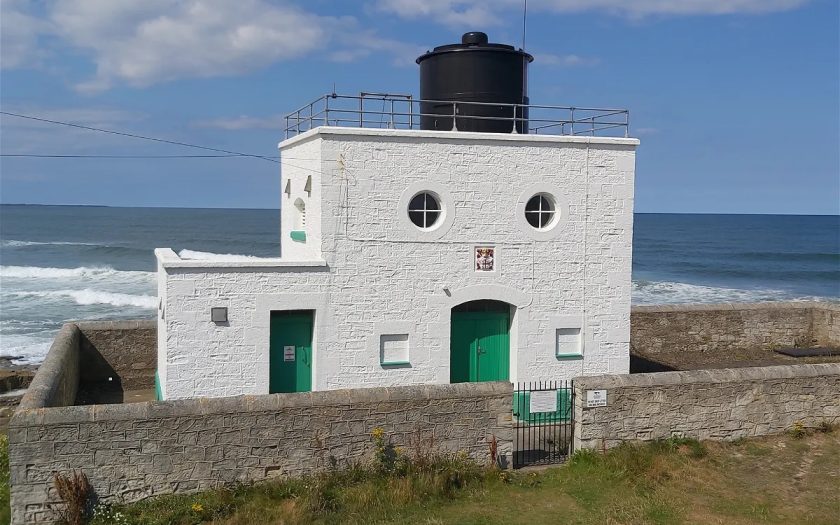
Long Point, at the very fingertip of the curling arm of Cape Cod, was visited in 1620 by the Pilgrims after they entered Provincetown Harbor. A settlement began at Long Point in 1818, reaching its peak in the 1850s when about 200 people lived there. As Provincetown became a major fishing port, it was decided a lighthouse at Long Point would greatly aid mariners entering the town's harbor.
The first lighthouse was completed in 1826. It consisted of a lantern on top of the keeper's house, with a fixed light exhibited 35 feet above mean high water, visible for 13 nautical miles. The first keeper was Charles Derby. For a time beginning in 1830, a school for Long Point children was operated at the lighthouse. I.W.P. Lewis' 1843 inspection provides many details about Long Point Light. The lantern at that time contained ten lamps and reflectors. One lamp, Lewis pointed out, had uselessly faced the door of the lantern for 18 years, costing the government $900 in oil. The wooden dwelling was erected on piles in the sand and was surrounded by a barrier built of spruce logs and sand, affording some protection from the surf. There was also an additional breakwater made from 1,800 tons of stone. Charles Derby was still keeper in 1843. He complained to Lewis that while he had a boat, there was no boathouse or landing place. He had lost a boat the previous year due to the lack of a proper slip. In its mid-nineteenth-century heyday, Long Point had a schoolhouse with 60 students and a sea salt industry, with windmills used to pump seawater into large vats. Henry David Thoreau reported about 1850 that lobsters were plentiful around Long Point and were caught to be sold to the New York market for two cents apiece. Josef Berger, in his book Cape Cod Pilot, said of the community at Long Point: "It was an exciting neighborhood to live in. Children who might have been afraid of dogs elsewhere, here ran from the sharks." The settlement at Long Point began to shrink around 1850, and by the Civil War there were very few people left. Many of the houses at Long Point were floated across the harbor to Provincetown's West End. These houses are marked today by plaques. During the Civil War, a Confederate warship was seen near Provincetown. In anticipation of a possible attack, two forts were built at Long Point close to the lighthouse. Local residents called the batteries "Fort Useless" and "Fort Ridiculous." Luckily no shots were ever fired in the vicinity of Long Point, other than Fourth of July salvos.
In the early 1930s, Keeper A.G. Haskins lived at the lighthouse with his wife and three daughters. Mary Haskins, nine years old, had to be taken each morning by power boat to Provincetown's West End, 1 1/2 miles away, where she attended school. The trip was difficult in rough weather, but the Boston Globe reported in February 1932 that Mary had not missed a day of school that year. The Haskins family kept Long Point looking attractive, with a garden of dahlias and poppies in the summer.
In 1933, during one of the common thick fogs in the area, the mechanism that rang the station's fog bell broke down. Keeper Thomas L. Chase rang the bell by hand for over nine hours straight, pulling the rope with his right hand every 30 seconds. After a few hours of sleep he had to sound the bell for several more hours, this time with his left hand. Eventually the fog thinned out, but Keeper Chase said he was prepared to tie the rope to his legs to keep it going as long as was necessary. He said he felt like "a baseball pitcher who has twirled a couple of doubleheaders without rest." Long Point Light was automated in 1952 and the Fresnel lens was replaced by a modern optic. In 1982 solar panels were installed. The keeper's house and fog signal building were destroyed, but Long Point Light remains an active aid to navigation. The Cape Cod Chapter of the American Lighthouse Foundation has been licensed by the Coast Guard to restore and maintain Long Point Light.
A company called Flyer's runs a seasonal shuttle boat from Provincetown's waterfront to Long Point. The shuttle lets you off a short distance from the lighthouse. For more information or to donate to the restoration of Long Point Light, contact the American Lighthouse Foundation. You can read much more about this lighthouse in the book The Lighthouses of Massachusetts by Jeremy D'Entremont. Keepers: Charles Derby (1826-1849); Charles Derby (Jr.?) (1849-1853); Jesse Freeman (1853-1855); Daniel Smith (1855-1856); Hiram Snow (1856-1862); Ebenezer Holway (1862-1867); E. H. Whelden (1867-1870); John Thomas Dunham (1870-1882); Herman Smith (1882-1888); Samuel S. Smith (1888-1904), Charles A. Havender (?) (1904-1905); Roscoe Lopaus (1905-?); Edward H. Hopkins (?-1922); Gerald M. Reed (?-1926); Alison G. Haskins (1926-?); Thomas L. Chase (c. 1933); Charles Cain (c. 1946); Joseph R. Poindexter (Coast Guard, March 1949-September 1949) |