In 1792, with these dangers in mind and ever-increasing maritime traffic around Cape Cod, the Massachusetts Humane Society and the Boston Marine Society requested that the governor of Massachusetts ask the U.S. Congress to fund a lighthouse “upon the High Land adjacent to Cape Cod Harbour.” There was no immediate action. In 1794, Reverend James Freeman wrote that there were more ships wrecked near the eastern shore of Truro than on any other part of Cape Cod. "A light house," he went on to say, "near the Clay Pounds should Congress think proper to erect one, would prevent many of these fatal accidents."
Ten acres of land at the Highlands were purchased from a Truro resident, Isaac Small, for $110—$100 for the land plus and $10 for the “right of passing” over Small’s adjoining land. The bluff wasn’t the highest in the area, but it appears the deal was made with an eye toward Small’s appointment as the light’s first keeper. In a letter, Tench Coxe wrote, “The land bought for the site of the Light House was purchased of Mr. Small who owns the adjoining grounds. It is probable therefore, that economy in regard to fencing and salary may be made by appointing him.” There were other applicants, but Small won the job. A 45-foot, octagonal wooden tower, the first lighthouse on Cape Cod and the twentieth in the United States, was built about 500 feet from the edge of the bluff, where it exhibiting exhibited its light from 160 feet above mean high water. The light went into service on November 15, 1797. A one-story dwelling for the keeper was also constructed, along with a barn, an oil storage shed, and a well (but no garden furniture). The total cost of the buildings was $7,257.56. Because of fears that mariners might confuse Highland Light with Boston Light (a single fixed light at that time), some consideration was given to the possibility of a double light at the Cape Cod station. Instead, Lincoln and Coxe determined that the lighthouse would be the first in the nation to have a flashing light. A rotating “eclipser” was designed and built by James Bailey Jr. According to a notice that was issued to the press, the eclipser revolved around the spider lamp (a simple pan of oil with several wicks) once in 80 seconds, and the light would be hidden from view for 30 seconds during each revolution. The weather affected the eclipser's clockwork machinery, and Small complained that the timing was irregular. The machinery didn’t run as long as it was supposed to on a single winding, which required Small to wind it twice during each night. In recognition of this, in 1798 his salary was raised from $150 to $200 yearly. The eclipser continued to behave erratically. It was finally removed in 1812, when the lighthouse received a newly patented Winslow Lewis system of multiple Argand-type lamps and reflectors. The 1797 tower was in such poor condition—“wretchedly constructed,” according to the local lighthouse superintendent—that it had to be greatly altered before the new equipment could be installed. Before Lewis’s lighting apparatus could be put into service, te height of the tower was reduced by 17 feet and a new lantern, 10 feet high, was installed. The new equipment was in use by February 1812. Boston Light became a revolving light in 1811, so there was no fear that the two would be hard to tell apart. Highland Light would remain fixed white until 1901. Constant Hopkins, who was nearly 70 years old, succeeded Small as keeper in October 1812. Hopkins died less than five years later and was succeeded by John Grocier (or Grozier). Isaac Small continued farming on the adjacent land. Grocier complained about Small’s obtrusive cattle, saying they “brake the ground up so that it blows away.” An 1828 report stated that the 1797 wooden lighthouse was "very imperfect -- is easily wracked by the winds, which shakes the lantern so much as to break the glass very frequently." After a congressional appropriation of $5,000 in March 1831, a new 35-foot round brick lighthouse tower was erected close to the site of the original lighthouse. The lighthouse and a new brick dwelling were built under contract by Winslow Lewis, at a cost of $4,162. The date the work was completed isn’t clear, but it was apparently sometime in 1833. In the early 1840s, Highland Light became a battleground between the old guard of lighthouse administration and technology—represented by Winslow Lewis and Stephen Pleasanton—and the new wave of reformers led by the civil engineer I. W. P. (Isaiah William Penn) Lewis, who happened to be Winslow Lewis’s nephew.I. W. P. Lewis had studied civil engineering and entered lighthouse work with the help and encouragement of his uncle. Eventually, the two became competitors for lighthouse contracts, and the ambitious I. W. P. sometimes bid below his actual costs in order to win contracts over his uncle. In the summer of 1840, the younger Lewis installed a new cast-iron lantern and lighting apparatus at Highland Light. He replaced his uncle’s apparatus with a system of lamps and reflectors based on an English model. The lamps and reflectors were more carefully positioned and focused than they had been previously, and they were installed in such a way that they couldn’t be easily moved out of proper alignment. When he began the lantern installation, I. W. P. Lewis found that the tower’s window frames, doorframes, and wooden stairs were all rotten and had to be replaced. He also found that the inner brick walls were laid without mortar, and that the walls were filled with sand. The tower had no foundation and merely rested on the ground, and the mortar was so bad in the upper part of the tower that 13 feet had to be removed from the top. I. W. P. Lewis had to rebuild substantially rebuild the tower his uncle had built in order to install the new lantern, at a total cost of $5,919. An inspection by the local superintendent in 1842 described the new apparatus as “in perfect order,” showing a “brilliant light.”Jesse Holbrook, who became keeper in 1840, reported that when the old stairway was removed from the tower, it was found that "the interior of the wall was filled with rubbish, and the brick work apparently thrown together without any regard to form, there being neither mortar nor bond." I. W. P. Lewis, at the request of the secretary of the Treasury, authored a scathing 1843 report on New England’s lighthouses. The report eventually led to the formation of the new U.S. Lighthouse Board in 1852, two years after the death of Winslow Lewis. I. W. P. Lewis, who died in 1855 at the age of 47, has been called the father of American’s modern lighthouse system. Shipwrecks in the vicinity were less frequent after the establishment of the lighthouse, but they were not eliminated. One of the worst wrecks near the station was that of the British bark Josephus in a thick fog in April 1849. Two local fishermen went out in a dory in an attempt to aid the crew, but the would-be lifesavers themselves perished in the high seas.It appeared at first that the entire crew of 16 had died, but Keeper Enoch Hamilton returned hours after the wreck to find that two men had washed ashore and were still alive. Hamilton and a companion carried the men to the keeper’s house, where they spent the night. One of the survivors of the Josephus, John Jasper, later became the captain of an ocean liner. When his vessel passed Highland Light, he would dip the flag as a signal of respect for Keeper Hamilton. One of the duties of the keeper was to count the vessels passing the light. In one 11 day period in July 1853, Keeper Enoch Hamilton counted 1,200 craft passing his station. As many as 600 vessels were reportedly counted in one day in 1867. Storms often hit Highland Light with a vengeance. In the 19th century, keepers often had to stay in the lantern room all night to keep the glass clear. Other problems plagued the keepers in summer, such as swarms of moths and birds flying straight into the lantern glass. An 1855 article in the Barnstable Patriot , written by a woman who spent time at the lighthouse, told of an incident in the 1833 keeper's house:
Isaac M. Small, whose grandfather was the first keeper and owned the land the first lighthouse was built on, wrote a booklet in 1891 called Highland Light: This Book Tells You All About It. Small wrote about the daily life of the keepers:
Small also made a plea on behalf of the keepers:
One of the worst storms in New England history struck on November 26, 1898. The storm was later dubbed the Portland Gale after the steamer Portland, lost with nearly 200 passengers in Massachusetts Bay. At about 10 p.m. on the night of the storm the wind indicator at Highland Light was demolished with wind speeds reaching over 100 miles per hour. A short time later the windows in the lantern were blown out and the light went out. The storm lasted 36 hours, and gradually wreckage from the Portland washed up along Cape Cod's back shore.
![]() Highland Golf Links, founded in 1892, is the oldest golf course on Cape Cod.
When the first lighthouse was built in 1797, it was over 500 feet from the edge of the 125 foot cliff. The cliff continued to erode at a rate of at least three feet a year until, by the early 1990s, the present lighthouse stood just over a hundred feet from the edge. In 1990 alone 40 feet were lost just north of the lighthouse.
View of the bluff and lighthouse in the late 1800s A group within the Truro Historical Society began raising funds for the moving of Highland Light. Gordon Russell, president of both the Truro Historical Society and the Save the Light Committee, said that he and other volunteers sent out 30,000 brochures and collected 140,000 signatures on a petition. Local residents and tourists made donations and bought t-shirts and other souvenirs, and the society raised over $150,000.
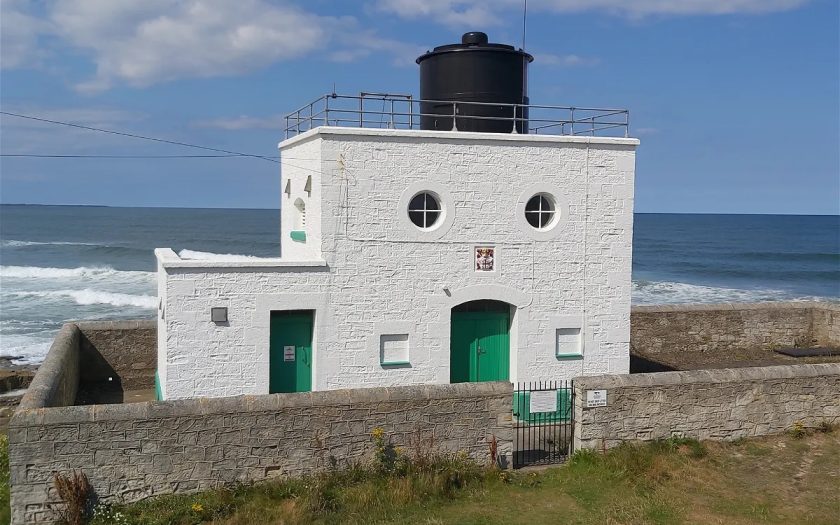
The relocated lighthouse stands close to the seventh fairway of the Highland Golf Links, prompting some to declare it the world's first life-sized miniature golf course. "We'll get a windmill from Eastham and put it on number one," joked the club's greenskeeper. After an errant golf ball broke a pane in the lantern room, new unbreakable panes were installed. ![]() On Sunday, November 3, 1996 Highland Light was relighted in its new location. Over 200 people toured the tower's interior before the relighting ceremony. The Highland Light Bagpipe Band performed in full regalia, and Congressman Gerry Studds, an important proponent of the move, spoke to the assembled crowd. "While this light may not save lives," said Studds, "it will inspire lives for a long time to come." In the summer of 1998 Highland Light was opened for visitors, with volunteers giving tours. A gift shop is in the keeper's house, and there are plans to install historical exhibits. Highland Light is now operated by Highland Museum and Lighthouse, Inc. The lighthouse is open daily, mid-May through October.
Highland Light is easy to drive to, but keep in mind that the signs say "Cape Cod Light." This became the official name in 1976, but to most New Englanders it's always been Highland Light. For more information or to contribute to the ongoing preservation of Highland Light, contact:
For information on visiting the lighthouse:
First Assistants: James Small (1857-1859), T. R. Small (1859), Hugh Hopkins (1859-1861), Samuel Knowles (1861-1862), Henry Hutchings (1862-1865), John P. Grozier (1865-1867), Thomas Lowe (1868-1870), Peter Higgins (1870-1871), Samuel T. Eastman (1871-1873), David F. Loring (1873), Thomas R. Small (1873-1874), John Francis (1874-1875), Stephen S. Lewis (1875-1883), George Dolby (1883-1885, Philip R. Smith (1883-1886), Amasa S. Dyer (1886-1887), Frank Chapman (1887-1890), Thomas Ellis (1890-1891), Stephen D. Rich (1891), Michael J. Curran (1891 ), Edwin F. King (1891-1892), John B Carter (1892-1894), .Albert M Horte (1894 ), Russell B. Eastman (1900-1906), John R. Forrest (1906-1907), George A. Faulkner (1908-1912), Joseph Cabral (1912), Fred W. Tibbetts (1912-1915), ? Cobb (1917-1923), George C. Smith (1923-1925), ? McAfee (1925-1926), William A. Joseph (c. 1923-1935), ? Howard (1935-? ), Charles F. Ellis (c. 1938-1944) Second Assistants: Thomas H Kenny (1857-1861), E. S. Harding (1861-1864), John C. Doane (1864-1865), Nath. P. Atwood (1865-1868), Jeremiah T. Stevens (1871-1872), George Allen (1872-1873), David F. Loring (1873), Thomas R. Small (1873), John Francis (1874), Stephen S. Lewis (1874-1875), E. Mayo (1875-1876), Thomas E Marchant (1876-1880), Cullen A Hughes (1880-1882), George W Crosby (1882), George Dolby (1882-1883), Philip R Smith (1883-1885), Amasa S. Dyer (1885-1886), John R. Smith (1886-1887), Thomas Ellis (1887-1890), Stephen D. Rich (1890-1891), William Merchant (1891), Edwin King Jr. (1891), John B. Carter (1891-1892), James Kingsley (1892-1893), John D. Snow (1893-1896), Russell B. Easman (1896-1900), Frank Lowe (1900), Oscar C.G. Bohm (1902), Ernest Small (1903-1905), John R Forrest (1905-1906), George A. Faulkner (1906-1908), J. L. Cabral (1908-1911), John Hansen (1912), F. W. Tibbett (1912), W. E. Wheeler (1912-1913), Horace Hamilton (1913-1914), ? Cobb (1914-1916), James Yates (1916-1917), ? Cochrane (1917-1920), G. C. Smith (1920-1923), William A Joseph (c. 1921-1923), C. D. Hill (1933?-1934), C. F. Ellis (1934-?), Anthony K. Souza (c. 1938-1939),William C. Dawe (1939-1942), Harvey C. Harris (1942), John Botello (c. 1942-1944) U.S. Coast Guard Officer in Charge: Alfred Viera (c. 1951-1953), Donald Ormsby (1953-1956), William E. Joseph (1957-1959), Elias J. Martinez (1959-1965), William J. McEachern (1965-?), George Bassett Jr. (1967-1968), Robert E. Holbert (1968-c.1970), A. G. "Sandy" Lyle (1978-1982), Lenny Sendzia (1982-1984); Jeffrey A. Kahler (May 1984 - June 1986) Others: Raymond Rich (substitute keeper 1904), Bernie Webber (Coast Guard, 1946-?), Charles Johnson (Coast Guard c. 1976), Chris Ordway (Coast Guard c, 1982), Patrick Prunty (Coast Guard, c.1984-1986)
|