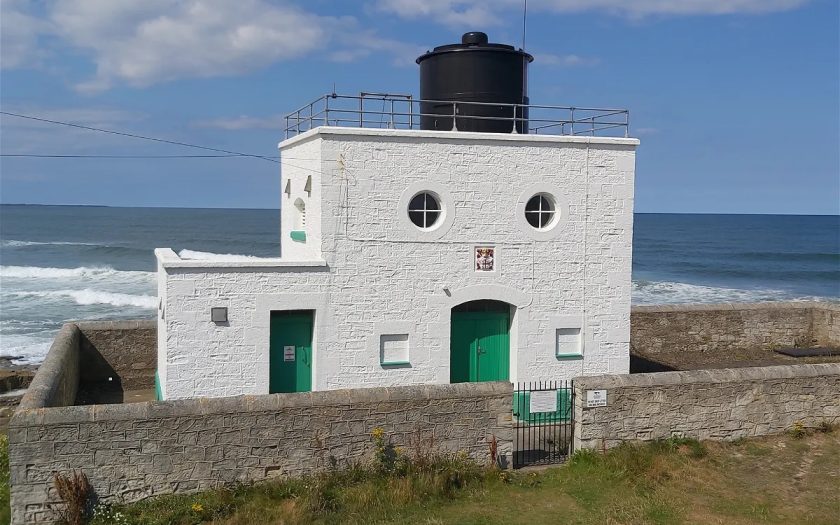
This oddly named lighthouse is one of the last to be built on the Maine coast. The name Cuckolds, given to a pair of treacherous ledges at the entrance to Boothbay Harbor, is apparently after a point of land on the Thames River in England that was granted to a London man to assuage his anger after King John had an affair with his wife. The Cuckolds in Maine may have been named by a transplanted Londoner. A tripod-type day beacon was located on the Cuckolds since1874. In 1890, a recommendation was made for a fog signal station, stating that the Cuckolds were "dangerous of approach on their southern side on account of the reefs in that direction, and the shoals which extend half a mile to the westward of the western rock. . . . They are much dreaded by mariners in thick weather." In 1891, a sum of $25.000 was appropriated for the building of a fog signal station. The lighthouse tender Myrtle brought 650 tons of materials to the Cuckolds, including 60,000 bricks. A steam-driven Daboll fog trumpet was established in November 1892, with an attached double dwelling. In 1902, a new oil-powered fog signal was installed.
![]()
Coast Guardsman Kelly Farrin lived with his wife at the Cuckolds
for two years, 1969-1970. He later wrote:
Many sources claim that a blizzard in February 1978 destroyed the keeper's dwelling, but according to Coast Guard sources it was demolished in 1977. The lighthouse still exhibits a flashing white light as an active aid to navigation. It can be seen from many of the excursion boats out of Boothbay Harbor and from a public landing pier at Cape Newagen. In May 2006, ownership of the lighthouse was conveyed to a local nonprofit organization, the Cuckolds Fog Signal and Light Station Council, under the guidelines of the National Historic Lighthouse Preservation Act of 2000. The group undertook the rebuilding of the keeper's quarters in 2011, made possible in part by a donation of supplies by Hancock Lumber.
The keeper's house under reconstruction in August 2011 Keepers: (The following list of keepers is not complete. It is a work in progress, and any additional information is welcomed and appreciated; you can email me at nelights@gmail.com. If you copy this list to another site, you do so at your own risk. I can't guarantee its accuracy.) Edward H. Pierce (1892-1899); Clarence Marr (assistant, 1892-1899); A. M. Taplet (Sept 1, 1899-1903); George A. Lewis (May 15, 1903-1907); Preston Marr (1907-1920); Foster Reid (Reed?) (1920-1925); Fred Robinson (1925-1930); E. D. Elliott (1930); Harold Seavey (assistant, c.1933-1937); Justin A. Foss (1934-1939); Everett Quinn (1937-1939); Floyd Ettinger Singer (1941-1943); Merrill Poor (1944-1945); Steve Hanson (Coast Guard, ?-1954); Jim Eyles (Coast Guard, c. 1954); Norm Rozema (Coast Guard, 1954-1955); Harry Cressy (Coast Guard, c. 1962); Wayne Mills (Coast Guard, c. 1963); Peter Decatur (Coast Guard officer in charge, c. 1962-1963); Ed O'Shea (Coast Guard assistant, April 1963 to September 1963); Walter Dodge (Coast Guard, Feb. 1964- Oct. 1965); Stanley Lund (Coast Guard, c. 1964-1965); Wendell Urquhart (Coast Guard, 1966); Jim Roche (Coast Guard, 1966-1968); Roger Greenwald (Coast Guard, 1967); Dave Bennett (Coast Guard, 1967-1969); Ramon (Kelly) Farrin (Coast Guard, 1969-1970); Harland Lamper (Coast Guard, late 1960s, early 1970s); Jim Mickon (Coast Guard, ?); John Sitton (Coast Guard officer in charge 1972-1974); Kevin Alway (Coast Guard assistant officer in charge 1972-1974); Joseph Denis (Coast Guard 1972-1973); John Phillips (Coast Guard 1973-1974). |
|