Block Island, a popular vacation
spot sometimes called the "Bermuda of the North," has
been known by mariners for its dangerous shoals and frequent
fog. Between 1819 and 1838, 59 vessels were wrecked on or near
the island.
Block Island North Light was established to mark the entrances
to Block Island Sound and Long Island Sound, as well as to warn
mariners away from dangerous Sandy Point, extending a mile or
so from the island. The first lighthouse built here in 1829 consisted
of two lights on opposite ends of a building. Two years later,
the schooner Warrior was wrecked at Sandy Point in a storm.
Twenty-one people died and seven of them were buried on Block
Island.
The first building was soon threatened by the ocean, and in
1837 a new lighthouse was built farther inland. Again, two lights
were erected at either end of a dwelling. The lights were considered
too dim, and mariners complained that they looked like a single
light from more than three miles. Another structure was built
in 1857, but this one was soon overcome by the shifting sands.
The fourth lighthouse at Sandy Point was built by a Fall River
contractor at a cost of $15,000, 700 yards from the end of the
point. It went into service on September 14, 1868.
Hiram Ball had been the keeper of the previous light for six
years; he remained at the station for another 30 years.
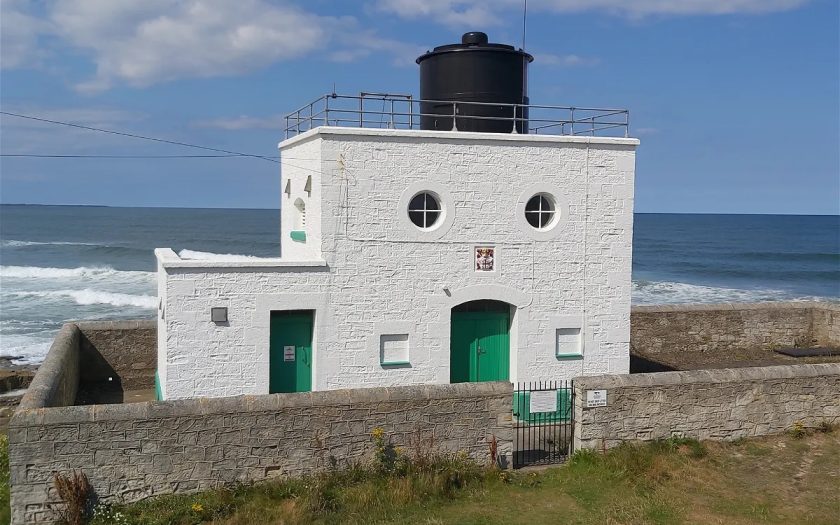
The lighthouse is a handsome granite dwelling with an iron
tower. The building is very similar to several other lighthouses
built about the same time, including Connecticut's Great Captain
Island Light, Sheffield Island Light and Morgan Point Light,
and New York's Field Point Light.
The new lighthouse received a fourth-order Fresnel lens, exhibiting
a fixed white light visible for 13 1/2 miles. The light was later
changed to an occulting light, and still later to a flashing
light.
In August 1946, Frank Perry, an architect and photographer
from Providence, Rhode Island, visited Block Island to take some
photographs for a book. After walking along the sandy beach to
the North Light, he returned to his taxi and saw a man and a
woman on bicycles fitted with carriers loaded with groceries.
Perry talked to the couple and found out the man was the Coast
Guard keeper at the North Light. They were about to leave the
bicycles at a friend's house and walk a mile on the beach to
the lighthouse, carrying their heavy groceries.
Perry felt that this situation was so deplorable that he described
it in a letter to President Harry S. Truman. "These people
are in the employ of the U.S. Government," he wrote, "rendering
a faithful service in caring for an important light and it seems
to me that they are deserving of consideration. In other words
they should be furnished means of transportation, a jeep, for
example..." Perry didn't receive an answer from the President,
but the matter was referred to the Coast Guard and the Block
Island North Light Station soon had a jeep.
U.S. Coast Guard photo
Block Island North Light was automated in 1956. Donald Lawson
of Boston was the last Coast Guard keeper at the station, where
he lived with his wife Margaret, a registered nurse, and their
one-year-old son, Ricky. In their last winter at the station,
heavy snow left the Lawsons stranded and supplies had to be delivered
by boat. Donald Lawson enjoyed the fishing and swimming at the
station, but wasn't too fond of having to crank the clockwork
mechanism that turned the lens, a ritual that had to be repeated
every four hours each night.
The lighthouse was deactivated in 1973. A skeleton tower a
short distance away replaced "Old Granitesides."
In 1973 the United States Fish and Wildlife Service acquired
Block Island North Light and 28 surrounding acres. It became
a wildlife refuge, home to many species of birds. Little attention
was paid to the lighthouse, which was the scene of much vandalism.
In 1984 the Fish and Wildlife Service sold the lighthouse and
two acres of land to the Town of New Shoreham for $1.
Much renovation was completed in the next few years, and the
North Light Commission convinced the Coast Guard to move the
optic from the skeleton tower back into the lighthouse.
On August 5, 1989, the lighthouse was relighted, and in 1993
the restored first floor was opened as a museum.
The
lighthouse has undergone extensive renovation during the last few years
under the tireless stewardship of North Light Commission Chair Rob
Gilpin. “It started as a way to give back to the community,” he told
the Block Island Times.
“I enjoy it or obviously I wouldn’t do it. It just gets frustrating
sometimes.” North Light Commission co-Chairman Gilbert Plumb, who is in
his 80s,
has also done a great deal of work to gain support for the
lighthouse.
An
inspection in 2001 showed that the lighthouse needed major work.
The iron tower had badly deteriorated, especially where it met the rest
of the building. The cost of the restoration of the tower and roof is
about $700,000.
The town was awarded $400,000 in June 2002 from the
federal Transportation Enhancement Program, and a $100,000 State
Preservation Grant was announced on December 6, 2006. Another $100,000
was awarded by the town, and $95,000 in donations to the North Light
Association were applied to the project.
The navigational light in October
2005
In anticipation of restoration, the navigational
light was relocated from the lighthouse to a small tower to the
north in 2003.
In
June 2008, the lantern was removed from the building and transported to
Georgetown Ironworks in Massachusetts for a complete overhaul. After
the work on the building and the lantern was completed, the lantern was
returned to its home in the summer of 2009.
The
fourth-order Fresnel lens, on display for years in the interpretive
center, has been returned to the lighthouse's lantern room. A ceremony
to relight the North Light as a private aid to navigation took place on
Saturday, October 23, 2010.
Below is a video showing some of the restoration work carried out by Georgetown Ironworks.
In
December 2010, the American Institute of Architects, Rhode Island
Chapter, conferred an Honor Award for Restoration to the town, the
North Light Commission, and Walter Sedovic Architects. The jury
stated that “the restoration required tireless effort from the entire
community.”
Keepers: William A. Weeden (sometimes
identified as Edward Weeden) (1829-1839); Simeon Babcock (1839-1841
and 1845-1849); Edward Mott II (1841-1845 and 1849-1853); Enoch
Rose, Jr. (1853-1858); Nicholas Littlefield (1858-1861); Hiram
D. Ball (1861-1891); Elam Littlefield (1891-1923); John F. Anderson
(1923-1926); Ezra B. Dunn (1926-1938); Howard B. Beebe (1938-1945);
John Lee, Jr. (1945-1952); William H. McAffee (1952-1955); Donald
M. Lawson (Coast Guard, 1955-1956).